Black Pepper and Bioavailability: Why Indians Add It to Everything
Medical Disclaimer
This content is for educational purposes only. It is not medical advice, diagnosis, or treatment. Consult your doctor or registered dietitian before making dietary changes, especially if you have a medical condition or are taking medication.
In This Article
The Spice That Makes Other Spices Work
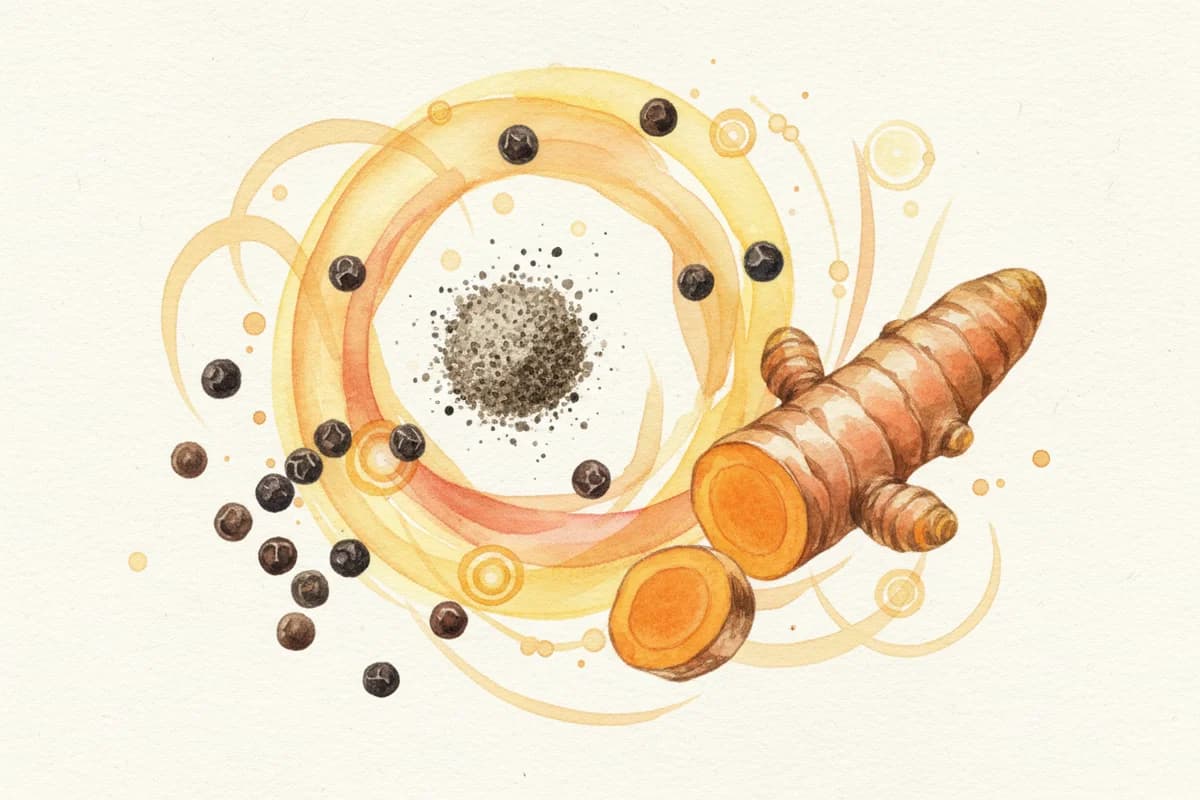
If turmeric is the star of the Indian spice box, black pepper is the stage manager who makes the whole show possible. Without black pepper, many of the health-promoting compounds in Indian food would pass through your body largely unabsorbed. With it, absorption rates increase by orders of magnitude.
This is not hyperbole. It is published, peer-reviewed science. And it explains one of the most persistent patterns in Indian cooking: why black pepper shows up in nearly every dish, every spice blend, and every traditional remedy.
Piperine: The Active Compound
Black pepper (Piper nigrum) contains approximately 5 to 9 percent piperine by weight, the alkaloid responsible for pepper's characteristic sharp heat. Piperine is chemically distinct from capsaicin (the heat compound in chili peppers) and works through different mechanisms in the body.
What makes piperine remarkable is not its flavor. It is what piperine does to other compounds you consume alongside it.
The Bioavailability Problem in Nutrition
Before diving into the research, it is important to understand why bioavailability matters.
Many of the most beneficial compounds in food, including curcumin from turmeric, resveratrol from grapes, and beta-carotene from vegetables, have a fundamental problem: your body does not absorb them well. These compounds are rapidly metabolized by the liver and intestinal wall through a process called first-pass metabolism. Much of what you eat gets broken down and excreted before it ever reaches your bloodstream.
This is why the question "is this food good for you?" is incomplete. The real question is: "how much of this food's beneficial compounds actually make it into your blood and tissues?"
This is where piperine changes the equation.
What the Research Says
The Landmark Curcumin Study
The most famous study on piperine and bioavailability was published in Planta Medica in 1998 by Shoba and colleagues [1]. This study measured curcumin levels in human blood after ingestion with and without piperine.
The results were striking: 20 milligrams of piperine (roughly the amount in a generous pinch of black pepper) increased curcumin bioavailability by 2,000 percent. That is not a modest improvement. That is the difference between a compound that barely registers in your bloodstream and one that reaches therapeutically relevant levels.
The mechanism is primarily inhibition of glucuronidation, the liver's main pathway for breaking down and eliminating curcumin. Piperine essentially tells your liver to slow down, giving curcumin more time to be absorbed.
This single study transformed our understanding of why Indian cooking pairs turmeric with black pepper. What appeared to be a flavor combination turned out to be a drug delivery system.
Beta-Carotene Absorption
Piperine's bioavailability-enhancing effects extend well beyond curcumin. A 1999 study by Badmaev and colleagues found that piperine significantly increased serum beta-carotene levels during oral supplementation [2]. Beta-carotene, the precursor to vitamin A found in carrots, sweet potatoes, and many Indian vegetables, is another compound with notoriously poor absorption.
The study found that 5 milligrams of piperine daily increased beta-carotene absorption meaningfully over a 14-day supplementation period.
Broader Bioenhancement
A comprehensive 2013 review in the Asian Pacific Journal of Tropical Biomedicine cataloged piperine's effects on the bioavailability of numerous compounds [3]:
- Curcumin: Up to 2,000 percent increase
- Beta-carotene: Significant increase (exact percentage varies by study)
- Selenium: Increased absorption in animal models
- Vitamin B6: Enhanced bioavailability
- Coenzyme Q10: Improved absorption in some studies
- Various pharmaceutical drugs: Including propranolol, theophylline, and others
The Mechanisms
Piperine enhances bioavailability through multiple pathways [3, 5]:
- Inhibition of hepatic and intestinal glucuronidation. This is the primary mechanism. By temporarily slowing the liver's phase II metabolism, piperine gives other compounds more time to be absorbed into the bloodstream.
- Inhibition of CYP3A4. Piperine inhibits this major drug-metabolizing enzyme in the liver, reducing the first-pass effect.
- Increased intestinal absorption. Piperine appears to increase the permeability of the intestinal epithelium, allowing more nutrients to cross into the bloodstream.
- Stimulation of digestive enzymes. Research suggests piperine may stimulate pancreatic lipase, amylase, and other digestive enzymes, improving overall digestion [5].
- Increased gut blood flow. Some evidence suggests piperine increases mesenteric blood flow, which could enhance nutrient uptake from the intestines.
Beyond Bioavailability: Other Health Effects
Digestive Health
Black pepper has been used in Ayurvedic medicine as a digestive aid for centuries. Modern research provides some support for this use. A comprehensive review by Srinivasan in Critical Reviews in Food Science and Nutrition noted that piperine stimulates the secretion of digestive enzymes, increases gut motility, and may help reduce intestinal transit time [5].
Anti-Inflammatory Properties
Piperine itself demonstrates anti-inflammatory activity in laboratory and animal studies. A 2013 review noted that piperine may inhibit NF-kB signaling and reduce the expression of inflammatory cytokines [4]. These effects are independent of piperine's bioavailability-enhancing role.
Antioxidant Activity
Multiple studies have demonstrated that piperine has direct antioxidant properties, scavenging free radicals and protecting cell membranes from lipid peroxidation [4]. The practical significance of these effects at dietary doses is still being studied.
Thermogenic Effects
Research suggests piperine may have mild thermogenic (metabolism-boosting) properties. Some studies indicate it may influence fat cell differentiation, though the evidence for meaningful weight management effects at dietary doses is preliminary [4].
The Indian Kitchen as a Bioavailability System
Here is what makes this research so fascinating in the context of Indian cooking: the traditional spice combinations in Indian cuisine are, from a bioavailability standpoint, remarkably optimized.
Consider a typical Indian dal preparation:
- Turmeric is added for color and flavor. It provides curcumin, a potent anti-inflammatory compound.
- Black pepper is added alongside the turmeric. Piperine increases curcumin absorption by 2,000 percent.
- Ghee or oil is used in the tadka. Curcumin is fat-soluble, so cooking it in fat further improves absorption.
- Heat from cooking partially breaks down cell walls and fiber matrices, releasing more bioactive compounds.
Now consider garam masala, the ubiquitous Indian spice blend. It typically contains black pepper alongside cinnamon, cardamom, cloves, and other spices. Each of these contains bioactive compounds whose absorption may be enhanced by the piperine in the pepper.
The same logic applies to chai. Traditional masala chai contains black pepper, ginger, cinnamon, and cardamom simmered in milk (fat). The piperine, the fat, and the heat all work together to maximize extraction and absorption of the beneficial compounds.
These combinations were not designed by biochemists. They evolved over centuries through the accumulated experience of millions of cooks. But they align remarkably well with what modern pharmacology tells us about nutrient absorption.
A Critical Caveat: Drug Interactions
The same properties that make piperine an effective bioavailability enhancer can also create problems with pharmaceutical medications. Because piperine inhibits CYP3A4 and glucuronidation, it can increase blood levels of certain drugs beyond their intended therapeutic range.
This is particularly relevant for:
- Blood thinners (warfarin and similar medications)
- Seizure medications (phenytoin, carbamazepine)
- Some blood pressure medications
- Certain immunosuppressants
What This Means for Your Kitchen
Black pepper is not an optional seasoning. In the context of Indian cooking, it is a functional ingredient that dramatically improves the nutritional value of your food. Here is how to use it effectively:
- Always pair black pepper with turmeric. This is the single most impactful nutrient-boosting combination in Indian cooking. Even a few cracks of fresh pepper with your dal makhani or curry make a measurable difference.
- Use freshly ground pepper when possible. Piperine degrades with time and exposure to light. Pre-ground pepper that has been sitting in your cabinet for months has significantly less piperine than freshly cracked peppercorns.
- Add pepper early in cooking, not just at the table. Some piperine is heat-stable and integrates better with other flavors when cooked. But also add a final crack at serving, since some piperine is volatile.
- Include black pepper in your spice blends. If you make your own garam masala or curry powder, black pepper should be a core ingredient, not an afterthought.
- Do not overdo it. You do not need large quantities. The 1998 curcumin study used just 20 milligrams of piperine, which is roughly one-eighth of a teaspoon of ground black pepper. Normal culinary amounts are sufficient.
- Be aware of medication interactions. If you take prescription medications, stick to normal dietary amounts and avoid concentrated piperine supplements without medical guidance.
The Bottom Line
Black pepper may be the most underappreciated spice in the world. While turmeric, ginger, and cinnamon get the headlines, black pepper quietly multiplies the effectiveness of everything else on the plate.
The research is clear: piperine is one of the most potent natural bioavailability enhancers known to science. And Indian cooking, through centuries of empirical refinement, has embedded it into virtually every dish, every blend, and every traditional remedy.
The next time you add a few cracks of black pepper to your food, you are not just seasoning it. You are activating it. That is what makes Indian cooking not just delicious, but nutritionally sophisticated in ways that modern science is only beginning to fully appreciate.
Sources and References
- [1] Shoba G, Joy D, Joseph T, Majeed M, Rajendran R, Srinivas PS. “Influence of piperine on the pharmacokinetics of curcumin in animals and human volunteers.” Planta Medica, 1998. View source
- [2] Badmaev V, Majeed M, Norkus EP. “Piperine, an alkaloid derived from black pepper increases serum response of beta-carotene during 14-days of oral beta-carotene supplementation.” Nutrition Research, 1999. View source
- [3] Kesarwani K, Gupta R. “Bioavailability enhancers of herbal origin: An overview.” Asian Pacific Journal of Tropical Biomedicine, 2013. View source
- [4] Butt MS, Pasha I, Sultan MT, Randhawa MA, Saeed F, Ahmed W. “Black pepper and health claims: a comprehensive treatise.” Critical Reviews in Food Science and Nutrition, 2013. View source
- [5] Srinivasan K. “Black pepper and its pungent principle-piperine: a review of diverse physiological effects.” Critical Reviews in Food Science and Nutrition, 2007. View source
Medical Disclaimer
This content is for educational purposes only. It is not medical advice, diagnosis, or treatment. Consult your doctor or registered dietitian before making dietary changes, especially if you have a medical condition or are taking medication.
Related Recipes
More on Nutrition

Get Weekly Nutrition Insights
Evidence-based articles on Indian food and health, delivered to your inbox. No spam, no fads, just science.