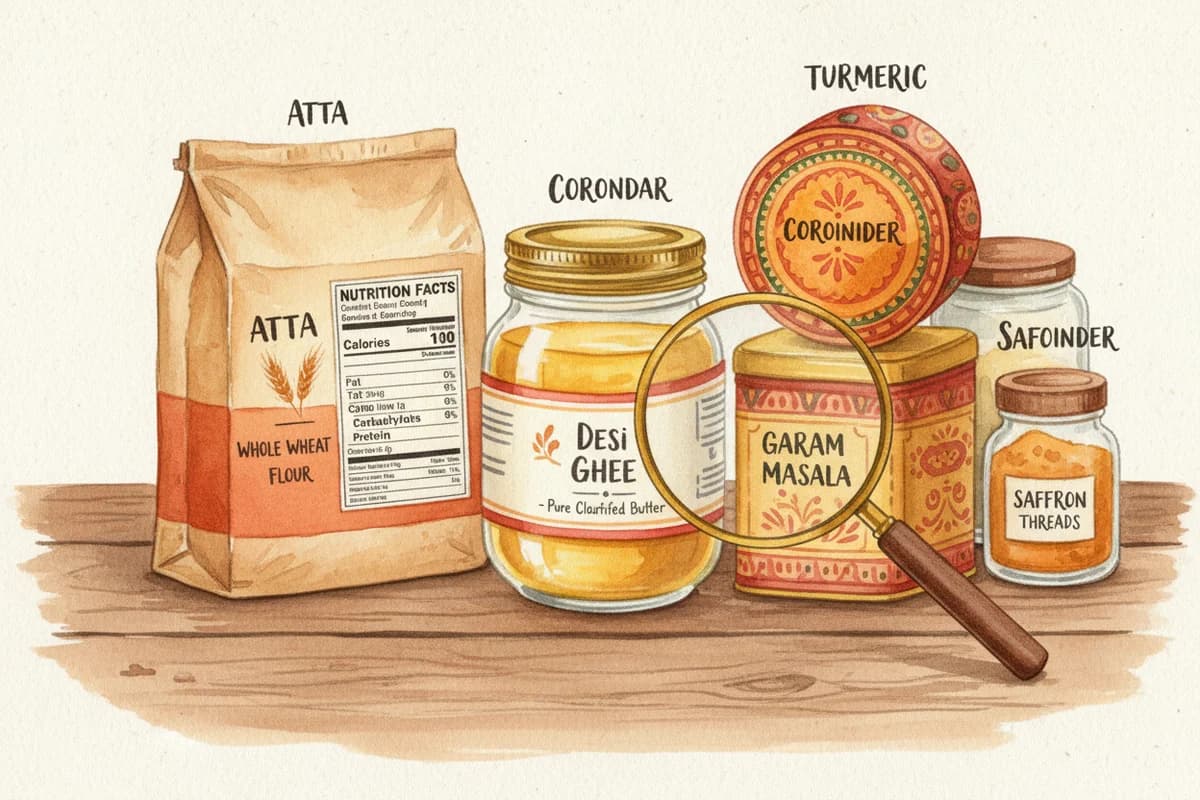
Every Indian grocery store aisle is packed with choices. Ghee brands compete for shelf space. Atta packets promise "high fiber." Pickle jars claim "no preservatives." Masala blends advertise "all natural." The nutrition label on the back of each product holds the truth behind these claims, but most shoppers never flip the package over. Those who do often find the numbers confusing or meaningless without context.
This guide breaks down exactly what every line on a nutrition label means, with a specific focus on Indian food products. By the end, you will be able to pick up any package of ghee, atta, dal, or ready-to-eat curry and know exactly what you are putting into your body.
Why Nutrition Labels Matter for Indian Food
Indian packaged food has exploded in variety over the past decade. Where your parents had two brands of ghee to choose from, you now face twenty. The same applies to atta, cooking oils, spice blends, ready-to-eat meals, snack mixes, and frozen foods. Many of these products carry health claims on the front of the package that range from genuinely useful to borderline misleading.
The front of the package is marketing. The nutrition label on the back is regulation. In India, the Food Safety and Standards Authority of India (FSSAI) mandates specific labeling requirements. In the US, the FDA sets the rules. Both systems require manufacturers to disclose calories, macronutrients, and ingredients in a standardized format. Learning to read this format takes about five minutes and will change how you shop forever.
The Anatomy of a Nutrition Label
Every nutrition label, whether on a pack of Haldiram's namkeen or a jar of Patanjali ghee, follows a standard structure. Here is what each section means.
Serving Size
This is the most important number on the label and the one most people ignore. Every other number on the label is calculated per this serving size. A packet of bhujia might list 150 calories, but the serving size might be 30 grams, roughly a small handful. The entire packet could be 150 grams, meaning five servings. If you eat the whole packet, you consumed 750 calories, not 150.
Always check the serving size first. Ask yourself: is this how much I actually eat? For many Indian snack products, the listed serving size is unrealistically small.
Calories (Energy)
Calories measure the total energy in a serving. Indian nutrition labels often list this as "Energy" in kilocalories (kcal) or kilojoules (kJ). One kcal equals 4.184 kJ.
For context, a moderately active adult needs roughly 1,800 to 2,200 calories per day. A single samosa from a packet might contain 180 to 220 calories. A tablespoon of ghee contains about 120 calories. These numbers are not inherently good or bad. They simply tell you how much energy you are consuming.
Total Fat
This line tells you the total grams of fat per serving. Below it, you will usually see a breakdown into:
- Saturated fat: Found in ghee, coconut oil, butter, and full-fat dairy. High intake is linked to elevated LDL cholesterol in some individuals. The American Heart Association recommends limiting saturated fat to less than 13 grams per day on a 2,000-calorie diet.
- Trans fat: Artificially created through partial hydrogenation of oils. Found in some margarines, bakery products, and cheaper vanaspati (hydrogenated vegetable fat). There is no safe level of trans fat intake. Look for 0 grams.
- Unsaturated fat (mono and poly): Found in mustard oil, groundnut oil, sesame oil, and rice bran oil. These are generally considered heart-healthy when consumed in moderation.
Carbohydrates
This section shows total carbohydrates per serving, usually broken down into:
- Sugar: Includes both naturally occurring sugars and added sugars. A packet of mango pickle will have some sugar from the fruit. A packet of gulab jamun mix will have far more from added sugar. The WHO recommends limiting added sugar to 25 grams per day.
- Dietary fiber: Found in whole wheat atta, dals, and vegetables. Most Indian adults do not get enough fiber. Look for products with 3 grams or more of fiber per serving. Whole wheat atta should have 10 to 12 grams of fiber per 100 grams. If it has less than 3 grams, it is likely refined or blended with maida.
Protein
Grams of protein per serving. This number is especially useful when comparing dal brands, paneer, soy products, and protein-enriched atta. A 100-gram serving of uncooked toor dal should contain 22 to 25 grams of protein. If a dal product shows significantly less, check the ingredients for fillers.
Sodium
Listed in milligrams (mg). This is where many Indian packaged foods become concerning. Pickles, papads, ready-to-eat curries, instant noodle masalas, and snack mixes are often extremely high in sodium. A single serving of store-bought pickle can contain 800 to 1,200 mg of sodium. The daily recommended limit is 2,300 mg, and ideally below 1,500 mg for people managing blood pressure.
When buying packaged Indian food, sodium is the number that deserves the most scrutiny.
The Ingredients List: What to Watch For
Below the nutrition facts panel sits the ingredients list. Ingredients are listed in descending order by weight. The first ingredient is what the product contains the most of. The last ingredient is what it contains the least of.
Red Flags in Indian Packaged Foods
Hydrogenated vegetable oil (vanaspati): Still found in cheaper snack mixes, biscuits, and some restaurant-style frozen foods. This is the primary source of trans fats. Avoid products that list this in the first five ingredients. Palmolein oil: A refined fraction of palm oil used in many Indian snack products for its low cost and high smoke point. It is not as harmful as hydrogenated oil, but it is high in saturated fat. Many brands use it in products labeled "cooked in vegetable oil" without specifying which vegetable. Added sugars under different names: Sugar appears on Indian labels as sucrose, dextrose, maltodextrin, corn syrup, jaggery powder, or invert sugar. A product with three different types of sugar in the ingredients list is designed to prevent sugar from appearing as the first ingredient. "Natural flavors" and "nature identical flavors": These terms are largely meaningless from a health perspective. A product labeled "natural" can still be heavily processed. Focus on the actual ingredients, not the descriptors. Preservatives: Common preservatives in Indian foods include sodium benzoate (INS 211), potassium sorbate (INS 202), and citric acid (INS 330). Citric acid is harmless and naturally present in lemon juice. The others are considered safe in approved quantities but indicate a heavily processed product.How to Decode Common Indian Food Labels
Ghee
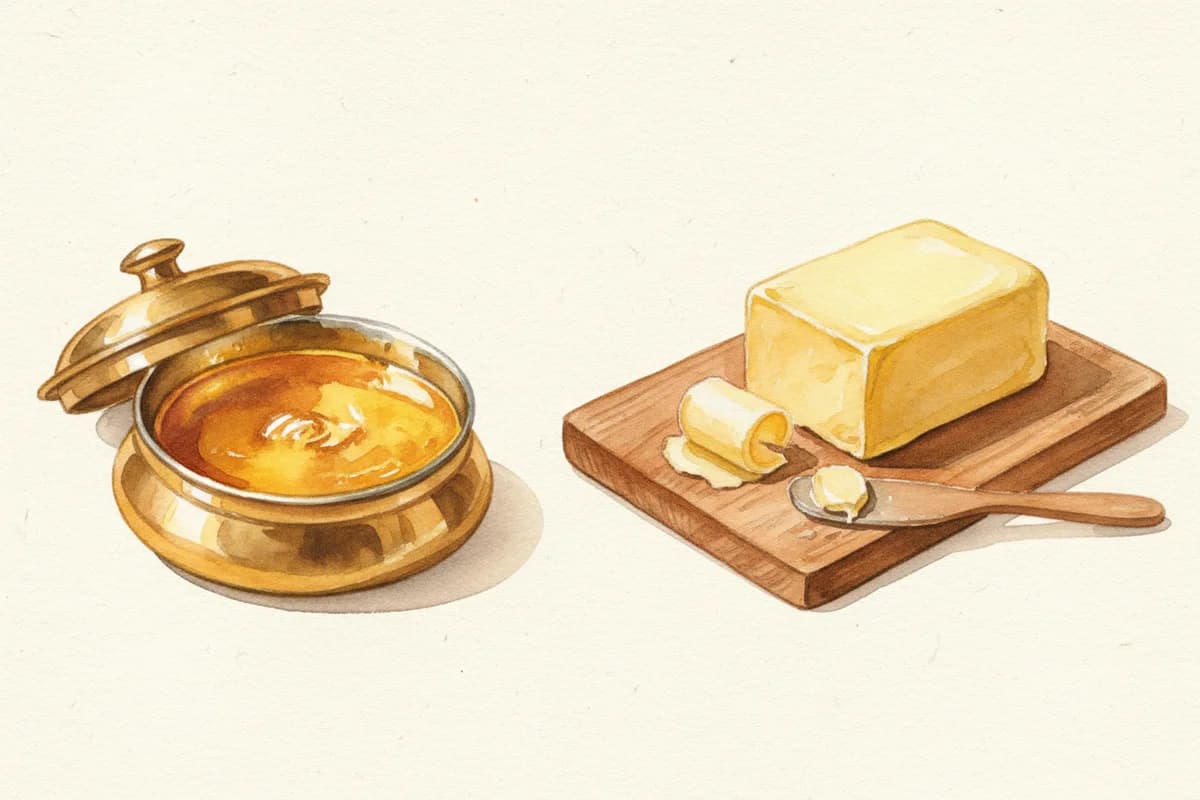
Good ghee should have exactly one ingredient: milk fat or cream. The nutrition per tablespoon (15 ml) should show approximately 120 to 130 calories, 14 grams of fat (8 to 9 grams saturated), and 0 grams of protein, carbohydrates, and sodium. If the label shows anything other than milk fat in the ingredients, or if the calorie count is significantly lower than 120, the product may be adulterated or blended with vegetable oil.
Atta (Whole Wheat Flour)
Pure whole wheat atta should list one ingredient: whole wheat flour. The protein content should be 10 to 13 grams per 100 grams. Fiber should be 10 to 12 grams per 100 grams. Many "multigrain" or "high fiber" atta brands blend in cheaper flours like maida (refined flour) or add isolated fiber supplements. Check the ingredients list. If maida appears before whole wheat, the product is mostly refined flour regardless of what the front of the package says.
Cooking Oils
All cooking oils contain approximately 120 calories and 14 grams of fat per tablespoon. The difference is in the fatty acid profile. Mustard oil is high in monounsaturated fat. Coconut oil is very high in saturated fat. Rice bran oil and groundnut oil sit in between. The label should specify the exact oil used, not just "vegetable oil" or "edible oil."
Pickles and Chutneys
Sodium is the critical number here. Traditional Indian pickles are salt-preserved, and a single tablespoon can contain 500 to 1,000 mg of sodium. Oil content varies widely. Some brands use mustard oil (traditional), while others use cheaper soybean or palmolein oil. Check the oil type in the ingredients list.
Ready-to-Eat Curries and Dals
These are where the gap between homemade and packaged is largest. A typical ready-to-eat butter chicken contains 250 to 350 calories per serving with 15 to 25 grams of fat and 600 to 900 mg of sodium. Homemade butter chicken, depending on the recipe, might contain 200 to 280 calories with 10 to 15 grams of fat and 400 mg of sodium. The convenience premium comes with extra fat, salt, and usually sugar.
Spice Blends and Masalas
Pure spice blends should list only spices. No salt, no sugar, no fillers. Many commercial garam masala and chaat masala blends add salt, sometimes as the first or second ingredient. This means you are paying spice prices for salt. If salt appears in the first three ingredients of a masala blend, find a different brand.
The Percent Daily Value Column
The column on the right side of the label shows "% Daily Value" (%DV) based on a 2,000-calorie diet. This provides quick context:
- 5% DV or less is considered low for that nutrient
- 20% DV or more is considered high
Five Rules for Smarter Indian Grocery Shopping
- Flip every package. Never buy based on front-of-pack claims alone. The nutrition label and ingredients list tell the real story.
- Check serving size first. A product can appear low-calorie or low-sodium by listing an unrealistically small serving size. Always calculate for the amount you actually eat.
- Compare per 100 grams. When choosing between two brands of the same product, compare nutrition values per 100 grams rather than per serving. This eliminates the serving size manipulation problem.
- Read the first three ingredients. The first three ingredients make up the bulk of the product. If sugar, salt, or hydrogenated oil appears in the top three, reconsider the purchase.
- Ignore marketing claims. "Natural," "traditional," "homestyle," and "Ayurvedic" are not regulated health claims. A product labeled "Ayurvedic" can still be high in sugar, salt, and saturated fat. The label does not lie. The front of the package often does.
Common Label Claims on Indian Food Products, Decoded
| Claim | What It Actually Means |
|---|---|
| "No added sugar" | No sucrose added, but may contain jaggery, honey, or fruit concentrates |
| "Low fat" | Less than 3 g fat per 100 g. Does not mean low calorie |
| "High fiber" | At least 6 g fiber per 100 g. Verify in the nutrition panel |
| "No preservatives" | No synthetic preservatives. May still use salt, sugar, or oil as preservatives |
| "Cold pressed" | Oil extracted without heat. Better nutrient retention, but same calories |
| "Organic" | Grown without synthetic pesticides. Says nothing about nutritional content |
| "No cholesterol" | Meaningless on plant-based products (plants never contain cholesterol) |
| "Trans fat free" | Less than 0.5 g trans fat per serving. May still contain small amounts |
A Note on Indian vs. Western Labels
If you shop at both Indian grocery stores and mainstream Western supermarkets, you will notice differences in labeling standards. US FDA labels are more standardized and require disclosure of added sugars separately from total sugars. Indian FSSAI labels do not always make this distinction. Some imported Indian products in the US carry both FSSAI and FDA labeling, which can be confusing when the serving sizes differ.
When in doubt, use the per-100-gram values if available. This is the universal standard that allows direct comparison regardless of the regulatory framework.
Start With Your Next Grocery Trip
You do not need to memorize every number on every label. Start with one habit: flip the package and read the serving size, calories, and sodium. Within a few shopping trips, you will develop an intuitive sense for what is reasonable and what is excessive. The goal is not perfection. The goal is awareness. Once you see the numbers, you cannot unsee them, and your choices will naturally shift toward better options.
The recipes on this site are built from whole ingredients where you control every gram of salt, fat, and sugar that goes into the pot. But for the packaged products that fill the gaps, from atta to ghee to the occasional bag of namkeen, the nutrition label is your most reliable guide. Learn to read it, and it will serve you well for a lifetime of smarter eating.